Using AI in Content Creation for Car Dealerships: Smarter Marketing in 2026
-
6 min read
Published Date: July 12, 2026

AI in 2026 is a "digital coworker," moving beyond simple automation to run autonomous, end-to-end marketing workflows for dealerships.
The main challenge is digital fatigue; winning content combines AI's speed with human authenticity to build trust.
AI transforms content from static posts into dynamic, real-time conversations based on live data like inventory and customer behavior.
The strategy frees human teams from repetitive tasks to focus on relationship-building and closing deals.
Success requires starting with one bottleneck, measuring results, and moving towards a unified tech platform for seamless customer engagement.
In 2026, automotive marketing has reached a tipping point. Dealerships are moving beyond basic automation and adopting AI-powered video tools that help teams respond faster and create content more efficiently. Solutions like AI Video Agents provide added coverage when teams are busy, VIN-specific showcase videos help bring inventory to life instantly, and AI-generated flex videos ensure consistent messaging across campaigns. Rather than replacing dealership staff, these tools act as accelerators, helping teams maintain speed, personalization, and professionalism at scale.
The 2026 challenge: "digital fatigue" & fragmented journeys
The modern car buyer's journey in 2026 is a fragmented maze of social media, third-party marketplaces, and AI overviews. Dealerships face three primary content challenges:
Pricing & Inventory Volatility: With margins under pressure and incentives changing, dealerships must update pricing and incentive content across all channels in real-time or risk losing buyer trust.
The Content Gap: Consumers expect individualized targeting and confidence-building communication that addresses high interest rates and electrification concerns.
Digital Fatigue: Over-polished ads are being replaced by a demand for authenticity real customer stories and employee-generated content.
But here’s the crucial twist: in 2026, winning content isn't just AI-made it's AI-amplified. The most effective strategy combines the speed and scale of AI with the trust and authenticity of human stories. Think of AI as your production crew, handling the lights, camera, and editing, while your team members are the on-screen talent that builds genuine connection. This hybrid approach is the only way to cut through digital fatigue.
2026 AI solutions: From creation to action
AI has evolved from a "buzzword" into core infrastructure that powers the entire dealership.
AI Content Type | Human-Written (2024 Legacy) | Agentic AI (2026 Reality) |
VDP Descriptions | Static, generic features. | Inventory-specific listings optimized for local search intent. |
Email/SMS Drips | Time-based sequences. | Behavior-triggered messaging based on real-time website clicks or service history. |
Social Content | Weekly planned posts. | Real-time social commerce posts synced with current inventory levels. |
Video Production | Professional shoots only. | AI-powered virtual showrooms and AR demonstrations available in minutes. |
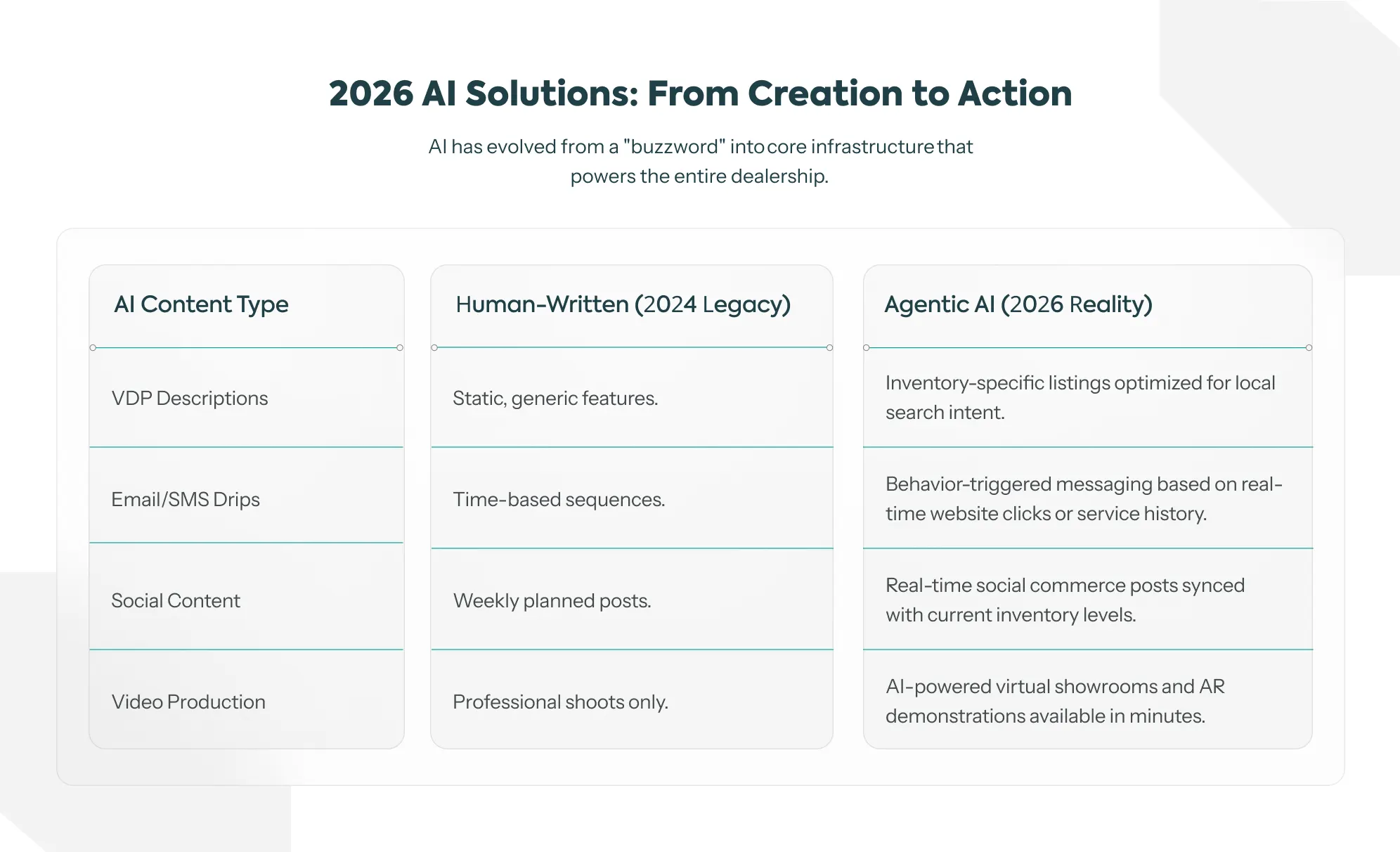
This table reveals the core of the 2026 marketing revolution:
A shift from static broadcasting to dynamic conversation. In the past, content was a manual, one-way announcement a generic description posted and forgotten. In 2026, AI transforms content into a living, responsive layer of your dealership. It listens to data (like what a customer clicks on or which cars aren’t selling) and instantly crafts the perfect response: a hyper-local VDP, a timely text, a social post that acts as a digital showroom floor. The goal is no longer just to inform, but to personally engage every potential buyer, in real-time, at the exact moment their interest peaks.
Visualizing the 2026 agentic workflow
In 2026, content isn't just "posted" it is orchestrated across systems.
1: Data Absorption (DMS/CRM/VDP) An AI agent monitors market signals, competitor pricing, and regional demand.
2: Autonomous Creation The system identifies slow-moving units and instantly creates custom social ads, price-drop emails, and updated web listings. 3: Multi-Channel Deployment Content is pushed to TikTok (using a platform like Automotive Ads), Google Business Profiles, and CRM automations simultaneously.
4: Real-Time Conversion As buyers engage, multimodal AI cockpits or virtual sales avatars handle inquiries 24/7, booking test drives directly into dealership calendars. In a robust 2026 workflow, the work may be distributed across multiple specialized AI agents, each with a defined role, which work together as a team. For example, one agent might handle data analysis, another might manage content generation, and a third oversees deployment to various channels. A lead orchestrator agent ensures seamless communication and task handoffs between them. This entire autonomous system functions as a continuous, 24/7 "digital coworker," freeing up human teams from repetitive operational tasks to focus on strategy, creativity, and relationship building.
Strategic implementation: 2026 action plan
Move Beyond "Bot-Only": While AI handles the mechanics of lead qualification and scheduling, human staff must focus on empathy and trust to close the deal.
Prioritize Local Search: Over 98% of auto searches are location-based; ensure AI tools are optimizing Google Maps and Business Profiles daily.
Collapse the "First Mile": Use Agentic AI to qualify leads and schedule appointments in under 2 seconds.
Unified Tech Ecosystems: Ditch disconnected tools; in 2026, winning dealerships use unified platforms that share a single customer profile across sales, finance, and service.
Your 2026 game plan should encompass smart teamwork between people and technology. Let AI handle the repetitive tasks like answering initial questions and booking appointments instantly this frees up your sales team to focus on what humans do best: building trust and closing deals.
At the same time, make sure you're impossible to miss locally by using AI to optimize your Google Business Profile daily, since nearly all car shoppers start with "near me" searches. Finally, ditch the messy patchwork of separate software systems and invest in tools that integrate with your CRM and other important technology and that give everyone in your dealership from sales to service a complete view of each customer. This isn't about replacing your team; it's about arming them with tools that work together seamlessly to win more business.
Bottom Line:
The question for 2026 isn't if you should use AI, but how strategically you can deploy it. The goal is to free your team from repetitive content tasks, empowering them to do what humans do best: build relationships, provide empathy, and close deals. Start by auditing one bottleneck whether it's VDP descriptions or social posts and implement a single AI agent to handle it. Measure the time saved and the engagement gained. That's the first step in transforming your dealership from a manual marketer into an autonomous, always-on sales engine.
In 2026, AI is the new competitive baseline. Dealerships that integrate AI across their entire workflow see up to 26% higher lead-to-sale conversion and significantly shorter sales cycles.
Frequently Asked Questions
No. AI handles repetitive tasks like writing ads and answering basic questions. Your team focuses on building trust and closing deals.
It works on its own. Instead of just helping with tasks, it independently monitors data, creates content, and engages customers across all channels 24/7.
Let AI handle the editing and posting. Use your staff and real customers to provide the genuine stories and videos that people connect with.
Pick one annoying, repetitive task like updating vehicle descriptions. Use an AI tool to fix that one thing first and see how much time you save.
So everyone (sales, service, AI) sees the same customer info. This lets you send timely, personalized messages, like offering a trade-in right after a service visit.